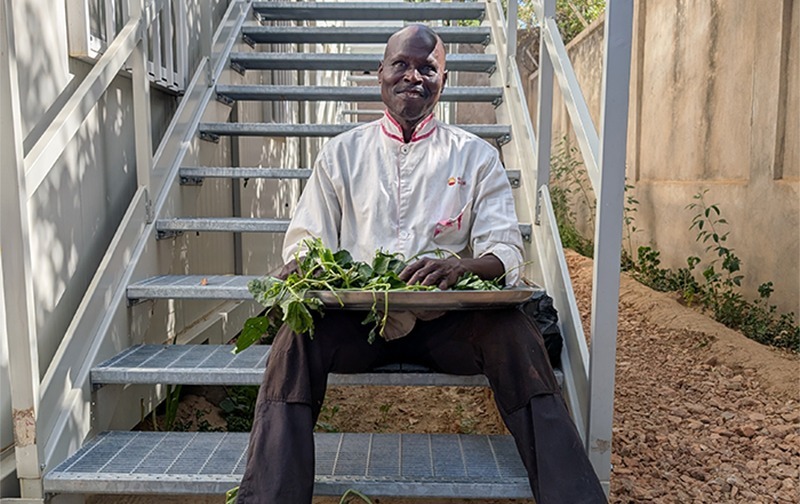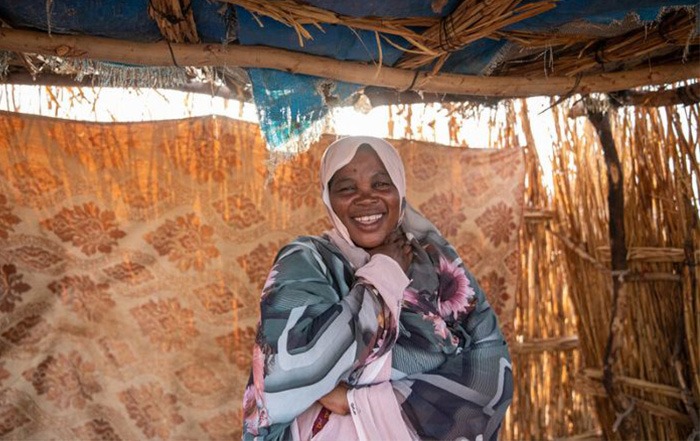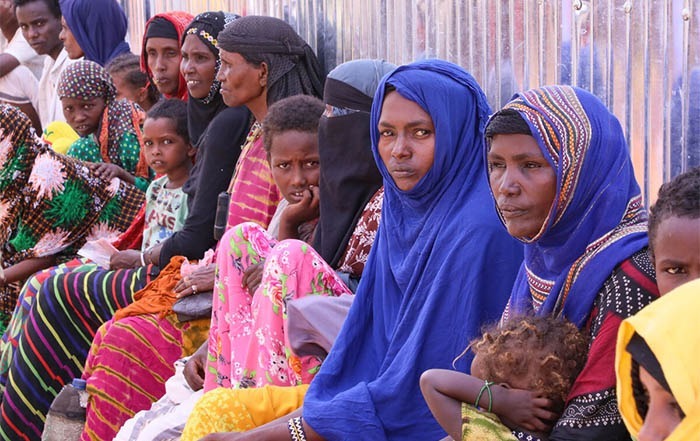
When disasters and conflicts force families from their homes, ShelterBox works alongside local partners to support people with emergency shelter and essential household items. At the heart of this work are ShelterBox Response Teams (SRTs) – trained volunteers who contribute their skills, experience and time to support responses around the world.
For Carsten, an SRT member based in Germany, this role has been part of his life for more than 11 years. His story reflects not only his own journey, but also how ShelterBox’s approach, and the wider humanitarian sector, continues to evolve.
Looking back: How did you first become involved as an SRT, and what drew you to the role?
Carsten first began thinking seriously about humanitarian work in 2008. At the time, it felt distant and intimidating.
“I thought humanitarian work was a big thing. I had no idea if I was suitable. I had a very protected, nice life in Germany.”
Still, the idea stayed with him. He applied to Médecins Sans Frontières (Doctors Without Borders) as a project logistician, fully expecting to be declined.
“They accepted me – and that was a shock. I thought, ‘I can’t do this.’”
Although a deployment never came through, the experience helped clarify what Carsten was looking for: a way to contribute meaningfully, but within a timeframe that worked alongside his job and personal life. A friend then told him about ShelterBox.
“ShelterBox felt like a childhood dream coming true. The idea that you could contribute something to society, to do something meaningful, really motivated me.”
He applied, was accepted, and completed his ShelterBox training before deploying for the first time in 2015.
Evolution of the role: How has the SRT role changed over time?
Carsten’s early deployments were highly practical and hands-on.
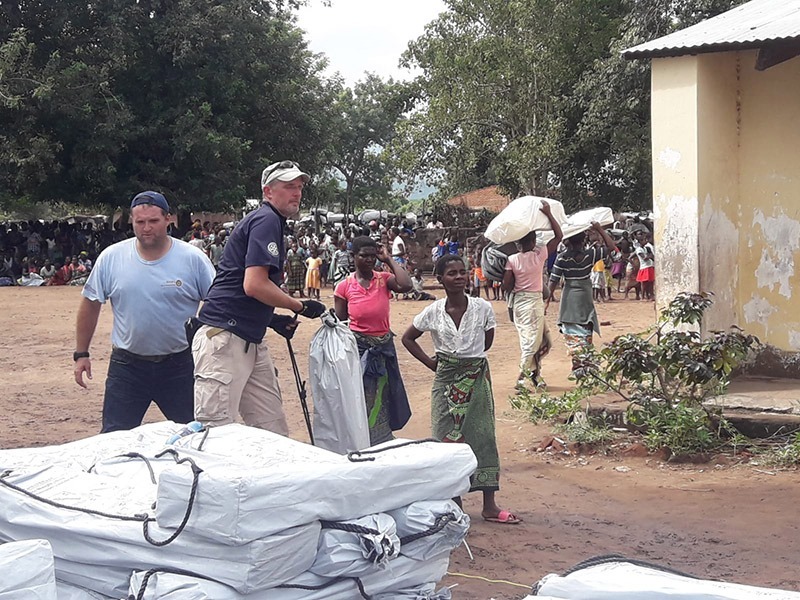
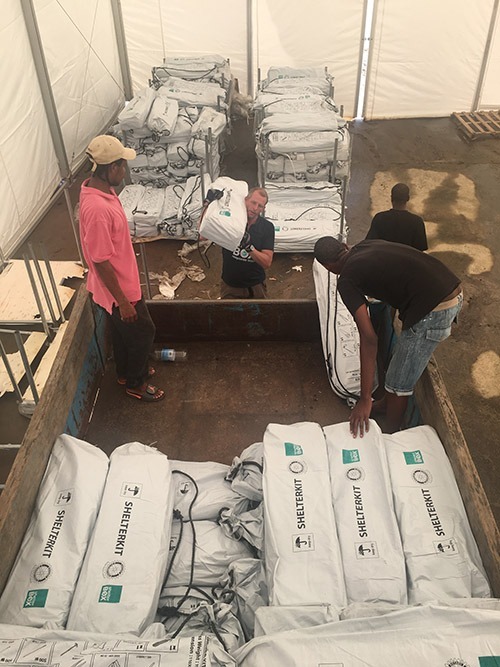
“At the beginning, it really was ‘pull up your sleeves’. You carried the boxes, you worked with your hands, you worked alongside people.”
His first deployment to Malawi was one of the last where ShelterBox distributed shelter boxes in the traditional way – each containing everything from a tent and sleeping mats to cooking equipment and a mosquito net.
“It was very much responding with head and heart.”
Over time, Carsten saw ShelterBox’s responses becoming more structured and process oriented – last but not least around safety, security, and accountability.
“There is now a much stronger framework. Though rules and standards sometimes set limits and add up complexity on deployment, our work increasingly professionalised over time”
Partnership has always been at the heart of ShelterBox’s approach. Over the years, Carsten has seen those relationships, with international organisations like the Red Cross and local organisations, become more structured, more intentional, and more embedded across every stage of a response.
“Humanitarian work carries responsibility. ShelterBox grew, and it needed clearer systems.”
While this evolution has changed what the SRT role looks like in practice, Carsten sees it as a necessary shift that strengthens how ShelterBox works alongside partners.
Current involvement: What does being an SRT look like for you now?
Today, Carsten’s involvement looks very different from his early deployments.
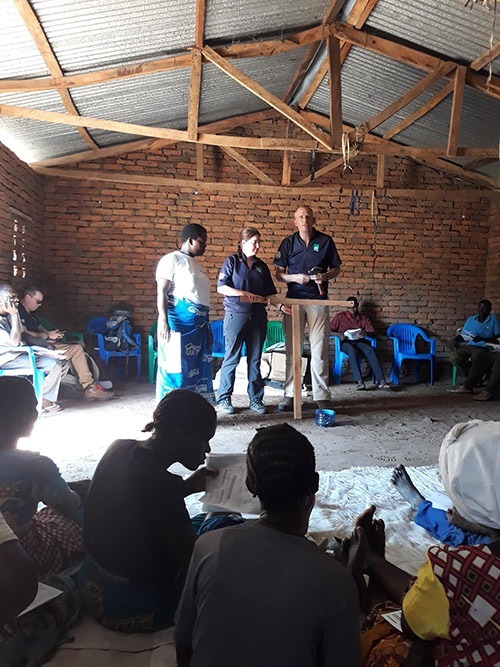
Following the COVID-19 pandemic, which paused many international responses, he became part of a capacity-strengthening and partner-scoping project in Malawi. Rather than distributing aid, the focus was on listening, learning, and relationship-building.
“The two weeks were exclusively about meeting local organisations – understanding who is doing what, and how a collaboration could make sense.”
The team met with several NGOs, documenting existing expertise and exploring where ShelterBox’s experience could add value.
“It became clear very quickly that this was about learning first, not coming in with a ready-made plan.”
Carsten’s professional background, working in business and partnership environments, became directly relevant.
“ShelterBox is increasingly using the specialised skills that already exist within the SRT roster.”
Impact and value: Why is it important that SRTs remain part of ShelterBox’s future?
For Carsten, the value of ShelterBox Response Teams lies in both motivation and diversity.
“We are resources for free – but more importantly, we are highly motivated. You wouldn’t do this voluntarily if you didn’t care deeply about the work.”
SRT members come from a wide range of professional backgrounds, including logistics, education, healthcare, emergency services, psychology, engineering and business.
“We bring perspectives from many different fields. That’s capital ShelterBox can use.”
Carsten sees this diversity as a strength.
“Seeing things from different angles is never a disadvantage – especially in complex situations.”
Personal reflections: What has been the most rewarding aspect of being an SRT?
For Carsten, the most rewarding part of being an SRT has been personal growth and perspective.
“I learned that I can do this – and that learning never really stops.”
He describes being deeply influenced by the resilience he witnessed in communities affected by crisis.
“I learned so much from people, about resilience, about dignity, about how teams work under pressure.”
Those experiences eventually led him to do an education as a therapist and coach.
“My work with ShelterBox changed the direction of my life. That’s something I’m incredibly grateful for.”
He’s also candid about global responsibility.
“I work in the technology industry, which contributes to climate change. That’s part of why disasters like cyclones are getting worse. Being an SRT is a way to take responsibility – even if it’s symbolic.”
Looking ahead: How do you see the role evolving in the coming years?
Carsten believes the future of humanitarian response lies in stronger local leadership and partnership.
“If local NGOs can professionally organize humanitarian aid for the affected communities themselves, that’s a good thing.”
For SRT’s work, he expects fewer hands-on deployments and more specialised, knowledge-based support.
“Capacity strengthening, technical training, professional knowledge transfer – I think that will grow.”
After more than 11 years as a ShelterBox Response Team member, Carsten sees his role, and ShelterBox’s, as part of a wider shift in the humanitarian sector.
“If the humanitarian system becomes more locally resilient, that’s success.”
As ShelterBox continues to strengthen partnerships and support local leadership, SRTs like Carsten remain an important part of that journey – bringing skills, curiosity and commitment to a model of response that puts people and communities at the centre.
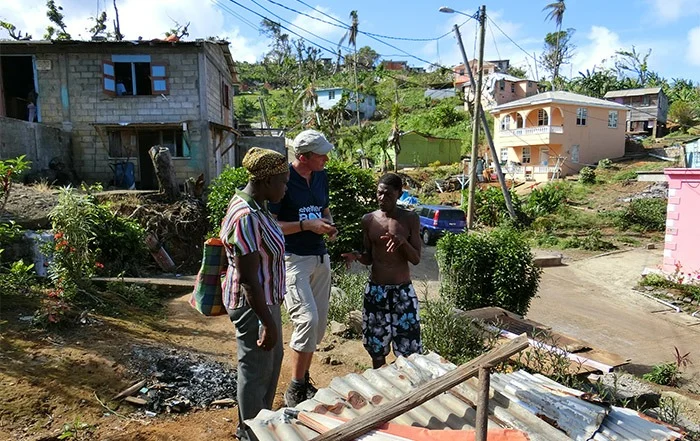
The heading image captures Carsten during aid assessments.