Where we work
Get the latest updates for our work and discover where we're supporting communities around the world in the aftermath of disaster and conflict.

Shelter is the foundation for life – for survival, stability and dignity. It offers a place to feel safe, stay together and stay healthy, earn a living and plan for the future.
ShelterBox provides emergency shelter and essential household items after disaster. There’s no one size fits all solution. Each disaster and community is different. So, we work flexibly, listening to what’s needed and adapting every time.
For some situations, family-sized tents are the best solution. They provide shelter until people can start rebuilding.
In other places, heavy duty tarpaulins, ropes and nails can patch-up damaged buildings.
Essential items like water filters, mosquito nets, and cooking sets help people survive.
Our teams also offer training on shelter building. This supports people to create robust shelters and maintain them over time. Trained people can then pass on their knowledge on to their community too.
Our support keeps evolving, and so do we.


Shelter kits help people repair homes after damage.
They include a range of tools like nails, a hammer, shovel and ropes. They can also include tarpaulins to make broken roofs or windows wind and rain proof. The kits can also include construction materials like wood or cement.
Shelter kits can vary a lot in their size and contents.
Explore Shelter Kits
After disaster, durable tents can help make people feel safe and protected.
Depending on the weather and the place, the types of shelter people need differ. Padded tents that safely accommodate a stove help protect people from freezing temperatures. In other situations, medium-sized tents that fit in small spaces might be preferred. Some tents can last years if needed. This helps people feel at home again.
Explore tents
Sometimes people can be forced from their homes for years at a time. When this happens, we can offer transitional or durable shelters.
Transitional shelters are for longer term occupation. They offer essential stability if people don’t know when they can return home. They’re often needed in camps or sites where people are a long way from where they lived. For example, in places like Cameroon and Burkina Faso where people have fled violence.
Materials include timber, cement, sand, and corrugated iron. Recently we have offered durable shelters in Pakistan and Somalia. We also provide training where needed, to ensure shelters are built to last.
Durable shelters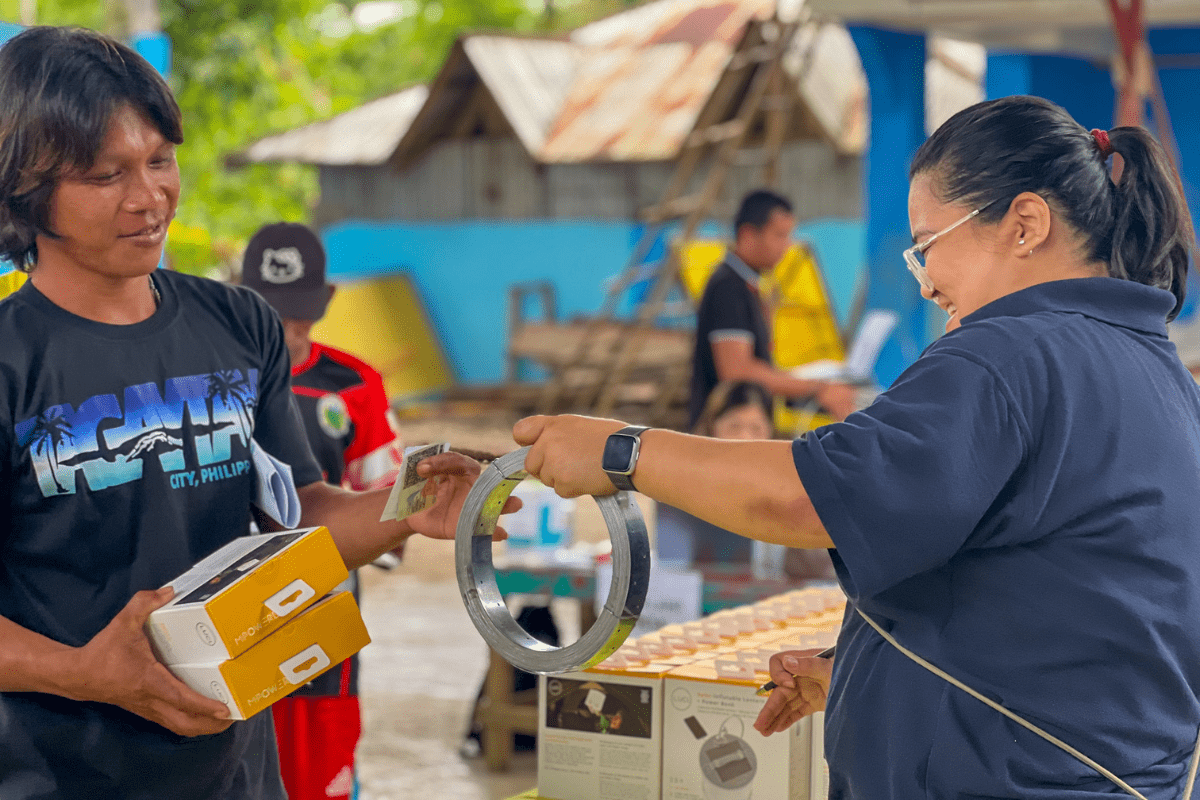
When strong winds hit, roofs are often the first part of a home to fail. Storm strapping helps to secure roofs to the rest of the structure, reducing damage during hurricanes, cyclones and typhoons.
We provide storm strapping alongside practical guidance, so people can strengthen their homes and make simple repairs. This support helps reduce future risk and gives families greater confidence in the safety of their shelter.
Storm strapping is a small addition, but it can make a significant difference – helping homes stay intact during extreme weather and supporting longer-term recovery.
Explore storm strapping

Our solar lights can last up to 24 hours on just one charge and can charge even on overcast days. As well as helping to chase away the dark when the power is down, they can also charge mobile phones.
They are lightweight, water resistant, and easy to carry in any situation. Helping to light the way for work, education, and mealtimes.
They provide comfort and help people to regain their livelihoods.
Explore solar lights

Blankets, mattresses, and groundsheets provide vital warmth and comfort. They help people get the sleep they need.
These simple items can be used in a variety of ways, from bedding to room dividers, and help turn a shelter into a home.

When disasters devastate the landscape and force people far from home, it can be hard to access safe, clean water.
By providing water containers and water filters, safe drinking water becomes one less thing to worry about.
Explore water filters
When people have lost their homes, they are often left without items that are key to survival.
Kitchen items like pots and pans, dishes, utensils, and cutlery help people to prepare meals.

In places where insect-borne diseases are common, mosquito nets are an effective way of keeping people safe.
These nets are coated with insecticide. This offers an extra layer of protection by killing insects on the net.
Explore mosquito nets


Sometimes we also offer cash after disaster when the conditions are right. This can offer people more control over their recovery and helps them get the things they need.
Tents, tarpaulins, and tools are at the heart of our disaster responses. But when it’s clear providing cash will have an even bigger impact on people’s lives, that’s what we’ll do.
Cash has recently been offered in our responses in Ukraine and Pakistan among others.
Discover more about cash assistanceTo respond faster and more efficiently when disasters strike, we pre-positions aid in strategic global locations. This reduces delivery time, lowers costs, and helps us reach communities in crisis more quickly. Each warehouse is stocked with enough supplies to support thousands of families, tailored to regional needs and response frequency.
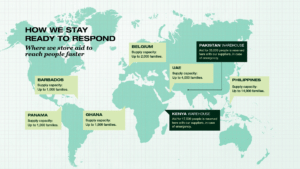
Located at the heart of Europe, our Belgium warehouse provides flexible support to Europe, the Americas, and West and Central Africa, as well as rapid-onset disasters globally. Supply capacity: Up to 2,000 families.
Strategically positioned to support our West Africa programmes, this hub enables faster regional responses. Supply capacity: Up to 1,500 families.
Our busiest hub, located between Africa and Asia, supports programmes in the Middle East and Southern Africa, and is key to responding to rapid-onset disasters. Supply capacity: Up to 4,000 families.
Pre-positioning supplies in Barbados allows us to respond faster across the Caribbean, while also cutting costs and lowering CO₂ emissions. Supply capacity: Up to 1,000 families.
Panama’s central location and proximity to the Panama Canal place it on major shipping routes in the Americas, making it ideal for regional response. Supply capacity: Up to 1,000 families.
Our most frequently responded-to country, with an average of two responses per year. In 2021, we established ShelterBox Operations Philippines Inc., a locally registered NGO supported by ShelterBox HQ in the UK. Supply capacity: Up to 14,000 families.
It depends. For example, a tent or tarpaulin located in a temperate climate could last for many years.
However, a tent or a tarpaulin could be in an improvised camp (where authorities have not had time to properly establish a camp). Here there is intense sun, heat, cold, and dust storms, and tents may not last as long due to extreme wear and tear.
When buying new aid items, we seek high quality and suitable items. We also work closely with our suppliers to increase the longevity of each aid item through improvements to their design.
Our International Programmesteam buys the best quality and most cost-effective aid items. We also make sure everyone, including our suppliers, follow high ethical standards.
After distributing aid items, we listen to the feedback from people who received them. Our team regularly check the performance, costs and suitability of our suppliers.
We try to source aid items locally when possible. This is better for the environment and supports the local economy. However, we only do this if we can ensure the right quality. For instance, the tarpaulins we supply are extra thick and robust. They have reinforced strips for fixings so they can be adapted easily. Locally procured tarpaulins usually don’t meet the same high spec.
We buy our aid items from a range of suppliers around the world. Our contracts are reviewed each year to ensure we are getting the best value possible. For these reasons, the prices of the items can go up or down over time.
Delivering shelter aid to people costs more than just the price of the items themselves. We also have to pay for transport and other distribution costs to get aid around the world.
To cover these extra costs, we’ve added them to the price of each aid item. These costs are calculated each year based on the previous year’s expenses and can change over time.

We started responding to disasters over 20 years ago. For a long time, we shipped our aid in our iconic green boxes. But today we’ve gone beyond the box, and we no longer use them. There are lots of reasons why.
Some of the items no longer fit in the boxes. Like our tents, which are bigger, so people have more space and privacy. We also buy items locally, which is better for the environment as it cuts our carbon footprint. Shipping aid on pallets means faster delivery and easier storage – closer to where disasters happen. We love our ShelterBoxes. We know our supporters do too. But it’s better for people and planet for us to focus on efficiency.
That means, today, we’re not boxing ourselves in.
Learn more